
Topic Battle

Where Everything Fights Everything

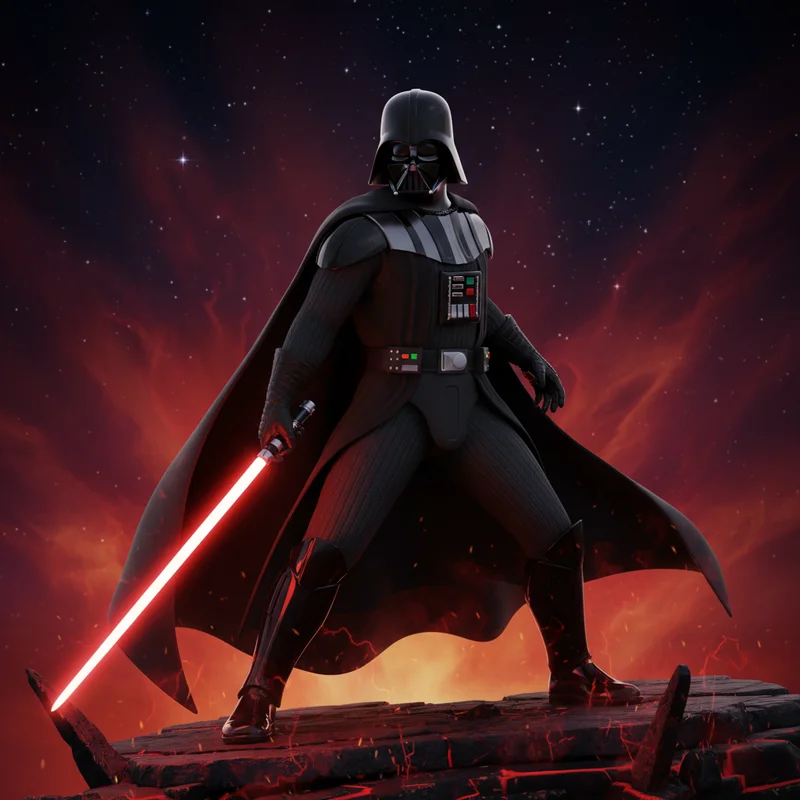
Darth Vader

Darth Vader

Sith Lord and cinema's greatest villain reveal.

VS
Money

Money

Abstract concept that runs the world.

Battle Analysis

Intimidation factor Money Wins
30%
70%
Darth Vader Money

Darth Vader

The intimidation methodology employed by Darth Vader represents a masterclass in psychological warfare. His entrance into any room is invariably preceded by the distinctive mechanical wheeze of his life-support apparatus—a sound so recognisable that it has been clinically demonstrated to elevate cortisol levels in test subjects who grew up during the original trilogy's theatrical run.

His preferred technique, the Force choke, allows him to discipline subordinates from across considerable distances, eliminating the need for proximity and establishing what organisational psychologists might term a 'remote management style with extreme prejudice'. Imperial officers have been observed displaying significantly improved performance metrics following demonstrations of this capability on their colleagues.

The aesthetic choices—entirely black attire, skull-like helmet, flowing cape—suggest a being who has given considerable thought to personal branding. One does not accidentally arrive at such a cohesive visual identity.

Money

Money's approach to intimidation operates through rather more subtle mechanisms, yet achieves arguably superior results. Unlike Vader, who must be physically present (or at least within Force-choking range), money exerts its influence through the simple threat of absence.

The fear of insufficient funds has motivated human behaviour far more consistently than any Sith Lord could dream of achieving. Individuals will tolerate soul-crushing employment, neglect their families, and compromise their principles—all without a single threatening hand gesture being necessary.

Consider the profound psychological weight of the phrase 'final notice'. These two words, printed on appropriately bureaucratic stationery, have induced more sleepless nights than the entire Galactic Empire's fleet of Star Destroyers. Money need not breathe menacingly; it merely needs to be potentially unavailable, and the terror follows organically.

VERDICT

The evidence strongly favours money in this category. Vader's intimidation, whilst cinematically spectacular, requires ongoing effort and physical presence. Money has automated the entire process.

Cultural penetration Money Wins
30%
70%
Darth Vader Money

Darth Vader

Since his debut in 1977, Darth Vader has achieved a level of cultural saturation that merchandising executives describe, in hushed and reverent tones, as 'the holy grail'. His image adorns lunchboxes, pyjamas, toasters that burn his likeness into bread, and an astonishing variety of products that would likely make the actual character question the dignity of the Sith order.

The phrase 'I am your father'—though frequently misquoted—has entered the lexicon of civilisation to such a degree that individuals who have never watched Star Wars nonetheless understand its dramatic significance. This represents a remarkable achievement in memetic propagation.

Vader's cultural influence extends across generations, with parents solemnly introducing their offspring to his malevolent presence as though conducting a sacred rite of passage. Few fictional characters have achieved such multigenerational relevance whilst wearing a cape.

Money

Money's cultural penetration is so complete, so thoroughly integrated into the fabric of human society, that we scarcely notice it—rather like breathing, or the inevitable approach of mortality. Every human civilisation of sufficient complexity has independently developed some form of monetary system, suggesting that the concept of money may be as fundamental to organised society as language itself.

Consider that money features prominently in every human culture's art, literature, religion, and philosophy. It appears in our metaphors ('time is money'), our measurements of worth ('money talks'), and our moral frameworks ('the love of money is the root of all evil'). One might argue that Darth Vader is merely a cultural phenomenon, whilst money is a civilisational constant.

Money also created the conditions for Darth Vader to exist. Without economic systems generating surplus wealth, there could be no film industry, no merchandising empire, no cultural apparatus to distribute his image globally. In a very real sense, money is Vader's maker.

VERDICT

Whilst Vader's cultural impact is genuinely impressive for a fictional character, money transcends the category entirely. It is not merely part of culture; it is the infrastructure upon which culture is built.

Philosophical weight Money Wins
30%
70%
Darth Vader Money

Darth Vader

Vader serves as popular culture's most accessible meditation on redemption, the corrupting nature of power, and the importance of proper ventilation in enclosed helmets. His narrative arc—fall, tyranny, ultimate redemption—mirrors countless religious and mythological templates, earning Star Wars its reputation as 'mythology for the modern age'.

Philosophically, Vader embodies the Nietzschean concept of the will to power taken to its destructive extreme, whilst his redemption suggests the persistence of goodness even within seemingly irredeemable figures. Undergraduate philosophy students have written countless papers exploring these themes, typically receiving marks of moderate distinction.

However, Vader's philosophical weight is necessarily mediated through narrative. He exists to illustrate concepts, not to embody them directly. He is a teaching tool, albeit an exceptionally dramatic one with excellent costume design.

Money

Money occupies a unique philosophical position as an abstraction that has achieved near-total ontological dominance over human existence. We have collectively agreed to organise our entire civilisation around pieces of paper, metal discs, and—increasingly—entries in digital ledgers. The philosophical implications of this arrangement have occupied thinkers from Aristotle to Marx to contemporary cryptocurrency enthusiasts who believe they have solved everything.

Questions surrounding money touch upon the nature of value itself, the relationship between symbol and substance, the ethics of accumulation, and the metaphysics of trust. When we exchange money, we are participating in one of humanity's most elaborate and successful collective fictions—a mass hallucination so effective that questioning it marks one as either a philosopher or a person of limited financial prospects.

Money also raises profound questions about human nature. Why do we desire it beyond any reasonable need? What does our relationship to money reveal about our relationship to mortality? These are not comfortable questions.

VERDICT

The distinction is categorical. Vader is philosophically interesting. Money is philosophically foundational. One generates undergraduate essays; the other generates entire academic disciplines.

Operational longevity Money Wins
30%
70%
Darth Vader Money

Darth Vader

Darth Vader's operational period spans approximately twenty-three years of in-universe time, from his mechanical reconstruction on Mustafar to his redemptive defenestration of Emperor Palpatine. During this tenure, he successfully eliminated numerous Jedi, oversaw the construction of two Death Stars, and managed to maintain his helmet's polish to an impeccable standard despite operating in various hostile environments.

In terms of real-world longevity, Vader has remained culturally relevant since 1977—nearly five decades of continuous influence. This is remarkable for any fictional creation, placing him alongside such enduring figures as Sherlock Holmes and Father Christmas in the pantheon of characters who have outlived their creators' original intentions.

However, one must note that Vader's continued relevance depends entirely upon the ongoing commercial interests of the Walt Disney Corporation and the nostalgia of ageing millennials. His immortality is, in this sense, contingent rather than absolute.

Money

The earliest known monetary systems date to approximately 3000 BCE in Mesopotamia, where clay tablets recorded debts and credits in a manner that would be recognisable to any modern accountant. This grants money an operational history of roughly five thousand years—and that is merely the formal, documented variety.

Prior to currency proper, humans employed various proto-monetary systems involving shells, beads, livestock, and other commodities of agreed value. The fundamental concept of symbolic exchange predates writing itself, suggesting that money, in some form, may be as old as human civilisation.

Throughout this extraordinary tenure, money has survived the collapse of empires, the rise and fall of religions, technological revolutions, and countless attempts to replace it with alternative systems. Vader, by comparison, has survived one corporate acquisition.

VERDICT

The mathematics here are unambiguous. Money has been influencing human behaviour since before the construction of the Great Pyramid. Vader premiered the same year as Saturday Night Fever.

Transformative capacity Money Wins
30%
70%
Darth Vader Money

Darth Vader

Vader's personal transformation—from promising Jedi prodigy to crispy Sith catastrophe—represents one of cinema's most compelling character arcs. His ability to transform others, however, is somewhat more limited, typically involving transformation from living being to deceased being, with occasional stops at terrified being.

The Force does grant Vader certain transformative capabilities. He can redirect the trajectory of objects, influence weak minds, and sense disturbances in the metaphysical fabric of the galaxy. These are not insignificant powers. However, they remain fundamentally reactive rather than generative—he can change the state of existing things but cannot create new economic systems or social structures.

His most significant transformative act—returning to the light side—destroyed the Galactic Empire but required his own death to accomplish. One might argue this represents rather poor transformation efficiency.

Money

Money transforms with the quiet efficiency of a universal solvent. It converts time into possessions, possessions into experiences, experiences into memories, and—through inheritance—memories into family disputes. No other human invention facilitates such comprehensive transmutation.

Consider the scope: money can transform a university education into a suburban home into a retirement into a legacy. It can transform social standing, relationship dynamics, political systems, and the physical landscape of cities. Dubai exists because of money's transformative capacity—an entire metropolis conjured from sand through the concentrated application of petroleum revenues.

Money also transforms behaviour with extraordinary precision. The promise of sufficient funds can convince humans to perform virtually any legal task, and a distressing number of illegal ones. This transformative power over human action is money's most remarkable property.

VERDICT

Vader's transformative capacity is personal and local. Money's transformative capacity is civilisational and continuous. One shapes scenes; the other shapes history.

👑

The Winner Is

Money

45 - 55

After rigorous analysis across five demanding criteria, Money emerges victorious with a score of 55 to Darth Vader's respectable 45. This outcome, whilst perhaps lacking the dramatic satisfaction of a lightsabre duel, reflects the fundamental nature of the contestants.

Darth Vader is, ultimately, a fictional character—albeit one of extraordinary cultural significance. His power, though cinematically impressive, exists within defined narrative boundaries. He cannot Force-choke your landlord, regardless of how much certain tenants might wish otherwise.

Money, by contrast, is a living abstraction that has successfully colonised human consciousness across virtually every culture and era. It requires no costume, generates no marketing expenses, and yet commands behaviour with a consistency that would make any Sith Lord envious.

The Dark Lord of the Sith is memorable. Money is inescapable. And in any honest assessment of influence, inescapability must triumph over memorability. Vader may rule a fictional galaxy, but money rules the one we actually inhabit.

Darth Vader
45%
Money
55%

Share this battle

More Comparisons