Topic Battle

Where Everything Fights Everything

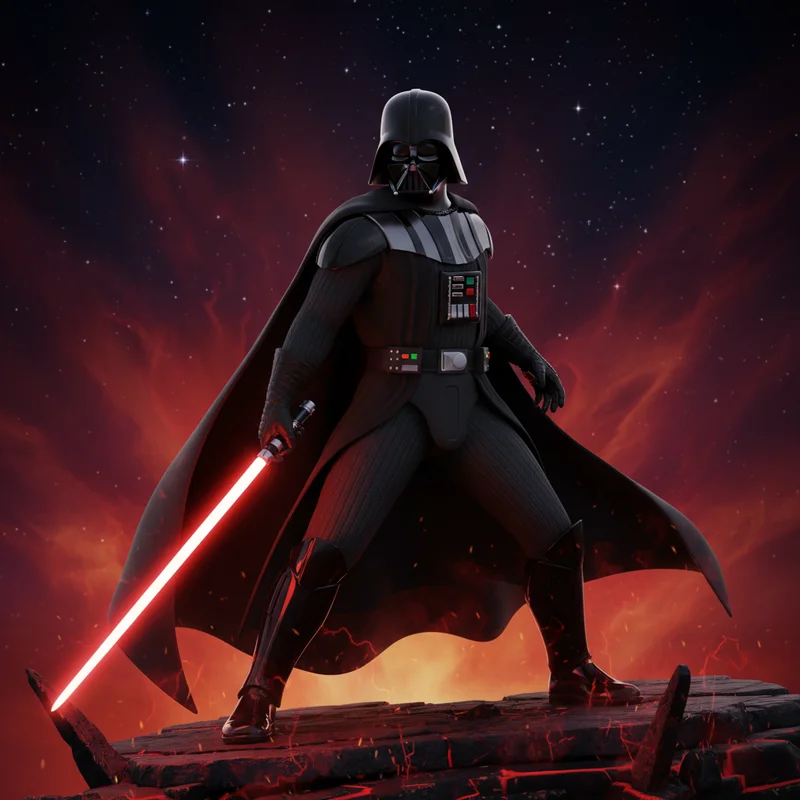
Darth Vader

Darth Vader

Sith Lord and cinema's greatest villain reveal.

VS
Time

Time

Dimension that refuses to slow down when needed.

Battle Analysis

Inevitability Time Wins
30%
70%
Darth Vader Time

Darth Vader

Darth Vader's menace derives substantially from his seeming inevitability within the Star Wars narrative. When his TIE fighter appears behind the Rebel fleet, when his respirator echoes through Death Star corridors, escape appears impossible. The Sith Lord pursued Luke Skywalker across the galaxy with single-minded determination, cornered Princess Leia aboard the Tantive IV, and tracked the Millennium Falcon to Bespin with the patience of a hunting spider. His mechanical enhancements render him nearly impervious to conventional attack; his Force sensitivity alerts him to danger before it manifests. However—and this proves crucial—Vader can be defeated. Luke bested him in combat. The Emperor's lightning nearly destroyed him. His own son's compassion ultimately unmade his dark persona entirely.

Time

Time's inevitability operates on an entirely different register. It cannot be fought, negotiated with, bribed, or Force-choked into submission. No entity in the known universe has successfully evaded time's passage. Stars burn through their hydrogen and collapse. Civilisations rise, flourish, and crumble to dust. Mountains erode grain by grain into the sea. The very protons that comprise matter may themselves decay given sufficient aeons. Time does not pursue its prey—it simply is, and everything else occurs within its embrace. Where Vader must expend tremendous energy to maintain his menacing presence, time expends nothing whatsoever. It merely continues, indifferent to the desperate struggles of those caught in its current.

VERDICT

Whilst Vader can be resisted, time defeats all opposition through sheer persistence.
Physical presence Darth Vader Wins
70%
30%
Darth Vader Time

Darth Vader

Darth Vader's physical presence was meticulously engineered for maximum intimidation. Standing over two metres tall in his armoured suit, cloaked entirely in black, his silhouette alone conveys menace. The helmet's design draws from samurai kabuto and Nazi stahlhelme, synthesising historical terrors into something timelessly threatening. His mechanical breathing provides an unforgettable auditory signature—a sound so distinctive that it triggers immediate recognition in listeners worldwide. Beneath the armour lies a man devastatingly burned by volcanic fire, kept alive through cybernetic intervention, his physical form simultaneously a prison and a weapon. When Vader enters a room, the very air seems to thicken with dread.

Time

Time possesses no physical presence whatsoever, which paradoxically represents both its greatest weakness and its ultimate strength in this category. One cannot see time, touch it, or photograph it. It leaves no fingerprints, casts no shadow, makes no sound. Yet its effects manifest everywhere: in the wrinkles on faces, the rings within trees, the sedimentary layers of geological strata. We measure time's passage through physical change—the swing of pendulums, the vibration of caesium atoms, the wheeling of planets around stars. Time is known only through its consequences, making its presence paradoxically more pervasive than any masked villain could achieve.

VERDICT

Vader commands immediate visceral presence; time remains forever abstract and imperceptible.
Cultural influence Time Wins
30%
70%
Darth Vader Time

Darth Vader

The cultural penetration of Darth Vader represents one of cinema's most extraordinary achievements. Since his first appearance in 1977, the Dark Lord has become universally recognisable iconography. His helmet adorns merchandise across every conceivable category. His breathing has been parodied, referenced, and homaged countless thousands of times. The revelation 'I am your father' ranks among the most quoted lines in film history—so pervasive that spoiler culture itself may have crystallised around that moment. Vader transcends his fictional origins; he has become a cultural archetype, the definitive modern representation of the fallen hero, the redeemable villain, the father whose love ultimately outweighs his darkness.

Time

Time's cultural influence proves simultaneously more fundamental and more difficult to quantify. Every human civilisation has grappled with time's nature, producing calendars, clocks, philosophies, and religions in response. The Mayans built their entire cosmology around temporal cycles. The Greeks distinguished between chronos (sequential time) and kairos (opportune moment). Modern physics has revealed time as a dimension intertwined with space itself. Literature overflows with temporal meditations, from Proust's madeleine to McEwan's Saturday. Where Vader shapes pop culture, time shapes culture entire—every story ever told occurs within its framework, every monument erected stands as defiance against its passage.

VERDICT

Vader dominates popular culture; time forms the foundation upon which all culture rests.
Transformative power Time Wins
30%
70%
Darth Vader Time

Darth Vader

Vader's transformative power operates through fear, violence, and occasional redemption. He can alter the trajectory of individual lives with terrifying efficiency—a Force choke here, a severed limb there, an entire planet rendered to asteroid debris through the Death Star he helped command. His transformation of Anakin Skywalker into cyborg nightmare demonstrates the Dark Side's capacity to remake individuals entirely. Yet Vader's transformations remain local in cosmic terms. He changes specific people, specific situations, specific battles. The galaxy's fundamental nature persists regardless of his interventions; stars continue burning, planets continue orbiting, life continues evolving on countless worlds beyond his reach.

Time

Time transforms everything, without exception or mercy. No structure, entity, or concept remains unchanged across sufficient temporal distance. Mountains become sand. Sand becomes stone. Stone becomes mountains once more. Species evolve, diversify, and vanish. Languages drift from Latin to Romance tongues to whatever linguistic forms will exist millennia hence. Even information degrades, memories fade, records crumble. The universe itself transforms through time—from primordial plasma to the current cosmic web of galaxies, eventually perhaps to heat death's final equilibrium. Where Vader's transformations are dramatic but bounded, time's transformations are gradual but absolute.

VERDICT

Vader transforms individuals and battles; time transforms reality itself, completely and irreversibly.
Philosophical significance Time Wins
30%
70%
Darth Vader Time

Darth Vader

Darth Vader embodies several profound philosophical themes with remarkable economy. His arc traces the classic tragedy of the fallen hero, exploring how good intentions can lead to monstrous outcomes. His relationship with Luke examines the tension between destiny and choice, nature and nurture, the possibility of redemption even after decades of villainy. Vader represents what Jung might term the Shadow—the dark potential within every person, the violence we suppress, the resentment we deny. His eventual return to the light suggests that identity remains fluid, that our worst actions need not define us eternally. These themes resonate precisely because they address universal human experiences.

Time

Time's philosophical significance dwarfs that of any fictional character, representing one of humanity's most persistent intellectual challenges. What is time? Does it flow, or do we move through it? Is the past real, or merely memory? The future potential, or already determined? Philosophers from Heraclitus to Heidegger have grappled with temporal questions without achieving consensus. Physics compounds the mystery: relativity reveals time as relative to observers, quantum mechanics suggests temporal symmetries, and cosmology raises questions about time's beginning and possible end. Time touches every philosophical domain—ethics (moral development), epistemology (memory and prediction), metaphysics (persistence and change), aesthetics (temporal art forms).

VERDICT

Vader illuminates specific philosophical themes; time constitutes a fundamental philosophical problem itself.
👑

The Winner Is

Time

42 - 58

This examination reveals an outcome that, whilst perhaps predictable, nonetheless illuminates something profound about the relationship between individual power and cosmic forces. Darth Vader claims victory in physical presence—his designed-for-intimidation silhouette remains unmatched for visceral impact. Yet across every other dimension, time proves triumphant. Its inevitability exceeds Vader's menace, its cultural influence predates and will outlast any fictional character, its transformative power reshapes reality itself, and its philosophical significance has occupied humanity's greatest minds for millennia.

The Dark Lord's defeat here should not diminish his achievements. Within his fictional domain, Vader represents the apex of personal power, a figure whose cultural impact has only grown across nearly five decades. Yet he remains, ultimately, subject to time like all things. His story has a beginning, middle, and end. His cultural relevance, however enduring, will eventually fade as new generations create new icons. Even the Star Wars franchise itself exists within temporal constraints.

Time asks no permission, accepts no surrender, and grants no victories. It simply continues, patient as geology, indifferent as entropy, absolute as mathematics. Against such an opponent, even the Dark Side of the Force proves insufficient.

Darth Vader
42%
Time
58%

Share this battle

More Comparisons