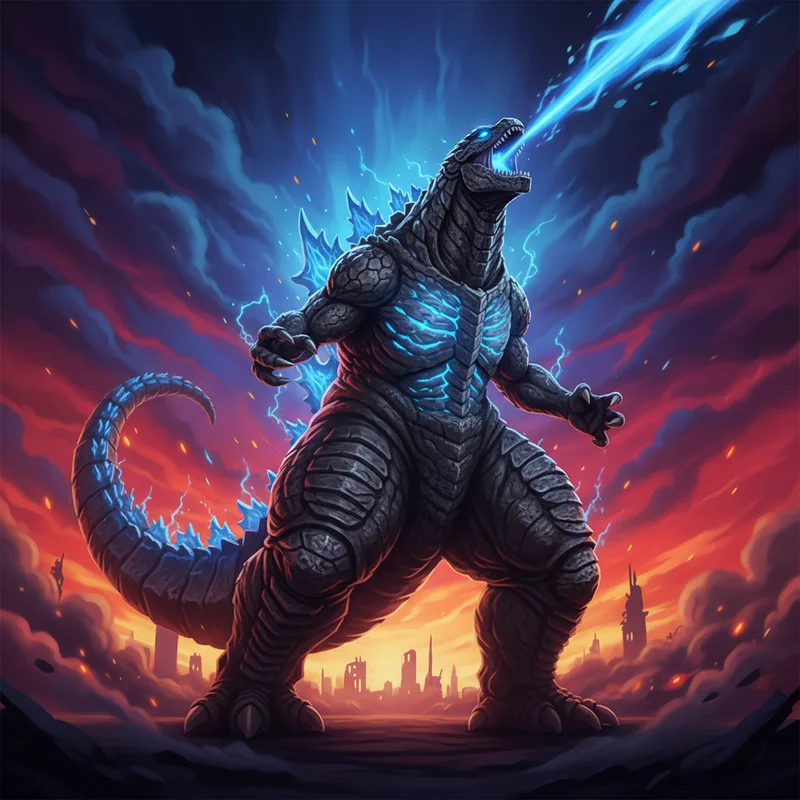

Godzilla
Measuring Godzilla presents fascinating scientific challenges, given the creature's tendency to destroy measuring instruments along with everything else in proximity. Height estimates across franchise iterations range from 50 to 120 metres, suggesting either significant growth spurts or continuity departments with limited zoological oversight. Mass calculations remain contentious, with estimates spanning 20,000 to 100,000 metric tonnes.
The creature's atomic breath output defies conventional calorimetry, as equipment melts before readings complete. Radiation signatures fluctuate between films. Biological samples prove difficult to obtain without casualties. Japanese defence forces have accumulated substantial behavioural data across decades, yet predictive models remain unreliable. The specimen essentially defies comprehensive measurement whilst remaining visually quite obvious from considerable distances.
Time
Time represents humanity's most precisely measured phenomenon. Caesium-133 atomic clocks define the SI second with nine-digit precision, enabling technologies from telecommunications to particle physics. International Atomic Time coordinates global measurement standards, whilst GPS satellites require relativistic corrections to nanosecond accuracy. Time measurement advances continually; optical lattice clocks now achieve uncertainties of 10^-18 seconds.
This extraordinary measurability has revolutionised human capability. Synchronised networks enable global financial transactions. Precisely timed experiments confirmed gravitational waves. Navigation systems locate positions within metres. The entire edifice of modern technology rests upon accurate temporal measurement. Ironically, despite this precision, philosophers remain uncertain whether time actually exists as a fundamental entity or merely as a convenient mathematical abstraction. The measurements, however, remain impeccable.