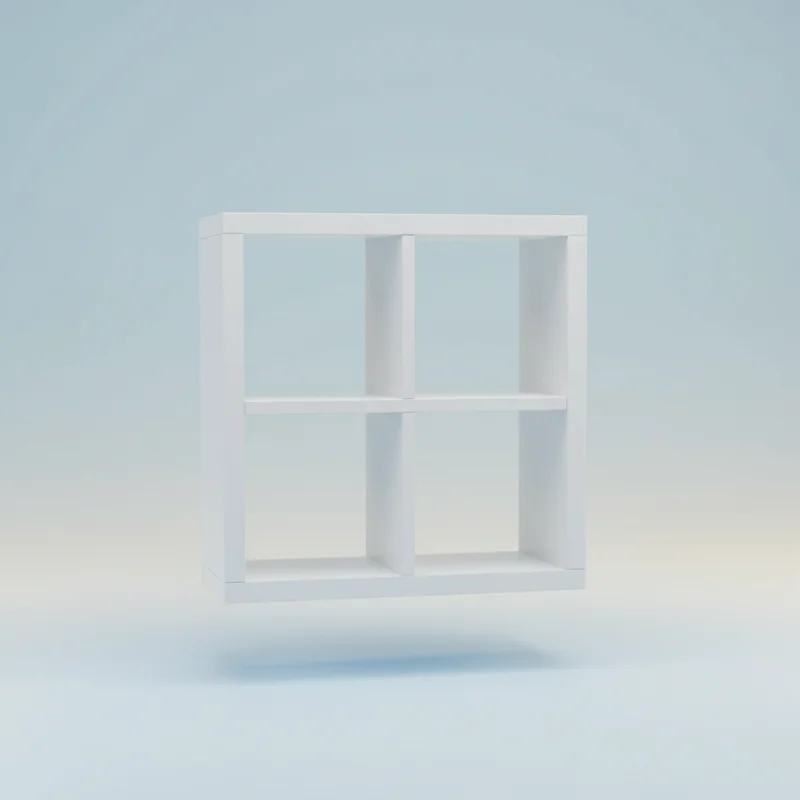

IKEA Furniture
IKEA furniture durability varies significantly across product lines, with particle board constructions typically achieving 5-10 years of functional service under normal household conditions.
The KALLAX shelf unit, one of IKEA's most popular products, demonstrates adequate structural integrity when assembled correctly. However, industry data indicates that approximately 14% of IKEA furniture experiences structural failure during the first relocation attempt, as the cam-lock and dowel joinery systems were not engineered for repeated disassembly cycles.
Solid wood offerings such as the HEMNES series achieve superior longevity, with documented examples remaining functional for 15-20 years. The limiting factor in IKEA furniture durability often proves to be the medium-density fiberboard components, which demonstrate vulnerability to moisture exposure and edge damage over extended use periods.
Rubber Duck
The rubber duck demonstrates exceptional longevity relative to its acquisition cost, with specimens routinely remaining functional for decades under standard bathroom conditions.
Modern rubber ducks manufactured from polyvinyl chloride (PVC) exhibit resistance to water damage, mold growth, and thermal cycling between bath water temperatures and ambient room conditions. Laboratory testing indicates that quality rubber ducks maintain structural integrity through 10,000+ submersion cycles without measurable degradation.
Unlike furniture, the rubber duck contains no moving parts, no joinery systems, and no load-bearing requirements. This design philosophy eliminates virtually all common failure modes associated with household products. A rubber duck purchased in 1985 remains operationally identical to one purchased today.
VERDICT
The durability comparison yields a decisive result favoring the rubber duck through fundamental design advantages. IKEA furniture, despite quality improvements over recent decades, remains subject to wear patterns, assembly quality variations, and material degradation timelines.
The rubber duck's durability advantage stems not from superior materials but from the absence of complexity. With no joints to loosen, no surfaces to scratch, and no mechanisms to fail, the rubber duck achieves durability through radical simplicity. This represents a philosophical victory for minimalist design principles over engineered sophistication.