Topic Battle

Where Everything Fights Everything

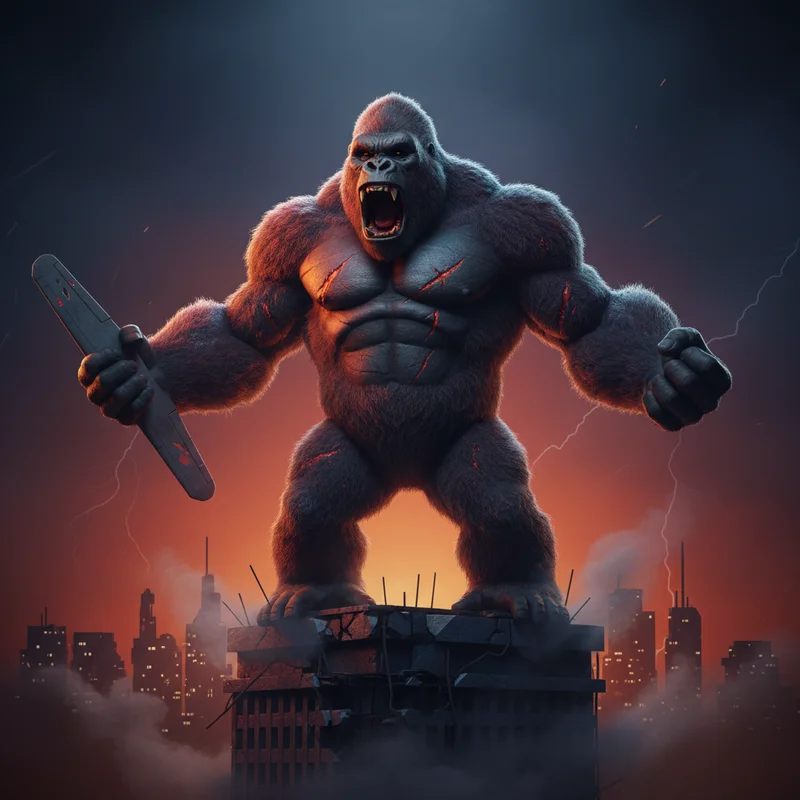
King Kong

King Kong

Giant ape with a thing for tall buildings.

VS
Time

Time

Dimension that refuses to slow down when needed.

Battle Analysis

Inevitability Time Wins
30%
70%
King Kong Time

King Kong

King Kong's appearances are decidedly not inevitable; they require specific conditions including film studios willing to invest considerable budgets, audiences willing to purchase tickets, and technological capabilities sufficient to render giant apes convincingly. Between his 1933 debut and 1976 remake, Kong remained dormant for forty-three years, demonstrating significant periods of complete absence.

Even when Kong does appear, his fate follows predictable tragic patterns: capture, display, escape, rampage, and ultimately fatal encounter with military hardware. This inevitability of outcome differs fundamentally from inevitability of occurrence. One can, technically, avoid King Kong by simply not watching films featuring King Kong. This represents a rather significant limitation.

Time

Time demonstrates absolute inevitability in ways that philosophical contemplation struggles to fully articulate. One cannot postpone Time, negotiate with Time, or purchase exemption from Time's dominion. Every attempt to outrun Time merely occurs within Time's framework, rendering such efforts rather philosophically futile.

The heat death of the universe, projected in approximately 10^100 years, represents Time's ultimate victory over all organised matter and energy. Stars will die, galaxies will disperse, and even black holes will eventually evaporate through Hawking radiation. Time will continue, utterly indifferent, into an eternity of cold darkness. King Kong, by contrast, falls off buildings when shot at.

VERDICT

One can escape King Kong by closing one's eyes; Time continues whether observed or not.
Cultural impact Time Wins
30%
70%
King Kong Time

King Kong

Since his 1933 debut, King Kong has become one of cinema's most enduring icons, spawning numerous sequels, remakes, and an entire franchise of monster-versus-monster spectacles. The image of the great ape atop the Empire State Building has achieved mythological status, recognised globally as a symbol of beauty's triumph over beast, or perhaps beast's doomed love for beauty.

Kong has influenced countless filmmakers, inspired theme park attractions, and generated billions in merchandise revenue. His 2005 Peter Jackson remake alone earned $550 million, whilst the MonsterVerse franchise continues to pit him against various atomic reptiles. The character explores themes of exploitation, captivity, and the tragedy of misunderstood creatures, resonating across generations and cultures with remarkable consistency.

Time

Time has inspired rather more philosophical contemplation than box office receipts, featuring prominently in every culture's mythology, literature, and scientific inquiry. From the Greek Chronos to Hindu concepts of cyclical ages, humanity has obsessed over Time's nature for millennia. Salvador Dali melted clocks, Einstein bent spacetime, and countless poets have lamented its passage.

The cultural footprint of Time encompasses every human artistic endeavour ever created, as all such works exist within its inescapable framework. Unlike King Kong, who appears in perhaps a dozen films, Time features in all films, all literature, and indeed all human experience. This omnipresence, whilst perhaps less cinematically dramatic, represents a scope of influence that no giant ape could reasonably match.

VERDICT

King Kong features in cinema; Time features in everything, including the very concept of cinema itself.
Physical presence Time Wins
30%
70%
King Kong Time

King Kong

King Kong presents a truly commanding physical specimen, standing between 25 and 100 feet tall depending on which cinematic incarnation one consults. His muscular frame, covered in coarse dark fur, weighs an estimated 60,000 tonnes in more recent depictions. The creature possesses opposable thumbs of considerable dexterity, capable of gently cradling blonde actresses whilst simultaneously batting away military aircraft.

His physical capabilities include exceptional climbing proficiency, demonstrated most famously upon the Empire State Building, and a formidable bite force that makes short work of prehistoric reptiles. The chest-beating display, accompanied by thunderous vocalisations, can be detected from considerable distances. However, these impressive physical attributes remain fundamentally bounded by biological constraints.

Time

Time presents a rather paradoxical physical presence, in that it possesses none whatsoever yet simultaneously pervades every atom of existence. One cannot see Time, touch Time, or indeed escape Time, making it rather difficult to appreciate from a purely sensory perspective. Unlike King Kong, Time has no fur, no teeth, and absolutely no capacity for chest-beating theatrics.

Yet Time's influence upon physical matter proves utterly devastating. Mountains crumble, oceans evaporate, and even the mightiest gorilla eventually succumbs to its patient ministrations. Time requires no climbing apparatus to surmount buildings; it simply waits for buildings to fall of their own accord. This patience, spanning billions of years, represents a rather unfair advantage in any physical contest.

VERDICT

Physical presence matters little when one contestant has the patience to witness the other's complete atomic dispersal.
Emotional resonance King Kong Wins
70%
30%
King Kong Time

King Kong

The emotional power of King Kong resides in his tragic vulnerability beneath the monstrous exterior. Audiences have wept for this creature across nine decades, moved by his doomed affection for Ann Darrow and his ultimate sacrifice atop New York's skyline. The famous closing line, 'It was Beauty killed the Beast,' captures the melancholic poetry at the character's heart.

Kong represents the outsider, the misunderstood, the magnificent brought low by a world too small for his grandeur. Children feel his isolation; adults recognise his futile struggle against forces beyond his comprehension. This emotional accessibility makes him universally sympathetic, a remarkable achievement for a character who spends considerable screen time destroying property and consuming humans.

Time

Time evokes emotions of profound existential weight, though these tend toward the contemplative rather than the immediately dramatic. The awareness of Time's passage generates nostalgia, regret, urgency, and the bittersweet appreciation of fleeting moments. Unlike King Kong's sudden, violent pathos, Time's emotional impact accumulates gradually, like sediment forming geological strata.

The grief experienced when loved ones age and depart, the panic of deadlines approaching, the wistful reflection upon youth's departure, all represent Time's emotional repertoire. These experiences lack the dramatic immediacy of a giant ape falling from a skyscraper but possess a depth of personal relevance that fictional creatures cannot fully replicate. Time makes us cry for real; Kong makes us cry for entertainment.

VERDICT

Kong delivers concentrated emotional catharsis; Time's impact, whilst deeper, lacks comparable dramatic immediacy.
Scientific significance Time Wins
30%
70%
King Kong Time

King Kong

From a strictly scientific perspective, King Kong presents numerous biological impossibilities that render him rather problematic. The square-cube law alone would prevent any terrestrial creature of his size from functioning; his bones would shatter, his heart would fail, and thermoregulation would prove catastrophic. Scientists have calculated that a gorilla scaled to Kong's proportions would require approximately 20,000 calories per minute simply to remain conscious.

Nevertheless, Kong has contributed to palaeontological discourse and public interest in prehistoric megafauna. His island home, populated by dinosaurs and other anachronistic creatures, has sparked countless young imaginations toward scientific inquiry. The creature represents impossible biology made compelling, even if actual biologists must suppress considerable frustration.

Time

Time occupies a central position in modern physics, from Newtonian mechanics through Einsteinian relativity to quantum mechanical interpretations. The nature of Time, whether it flows, whether it exists independently of events, whether the past and future are equally real, represents some of science's most profound unresolved questions.

Einstein demonstrated that Time dilates under gravitational influence and at relativistic velocities, fundamentally altering humanity's understanding of the universe. The thermodynamic arrow of Time, the relationship between Time and entropy, and the possibility of closed timelike curves continue to occupy the finest scientific minds. Compared to a fictional gorilla, Time represents a rather more legitimate subject of scholarly inquiry.

VERDICT

Time is fundamental to physics itself; Kong is fundamental only to suspension of disbelief.
👑

The Winner Is

Time

38 - 62

This analysis reveals a fundamentally asymmetric confrontation between a beloved fictional character and an inescapable cosmic constant. King Kong, for all his cinematic grandeur and emotional resonance, operates within constraints that Time neither recognises nor respects. The great ape may climb the tallest buildings and defeat the mightiest prehistoric reptiles, but he cannot outclimb entropy itself.

Time emerges victorious with a 62-38 margin, reflecting its advantages in physical impact, cultural omnipresence, scientific significance, and sheer inevitability. Kong's sole victory in emotional resonance, whilst meaningful, cannot overcome the fundamental disparity between a fictional creature and an actual dimension of spacetime.

Yet perhaps the most profound observation concerns their strange interdependence. King Kong exists only because Time allowed cinema to develop; his immortality in popular culture represents a kind of temporal victory. Time, conversely, gains meaning partly through the stories told within its flow. The ape and the abstraction, it seems, require each other more than either might admit.

King Kong
38%
Time
62%

Share this battle

More Comparisons