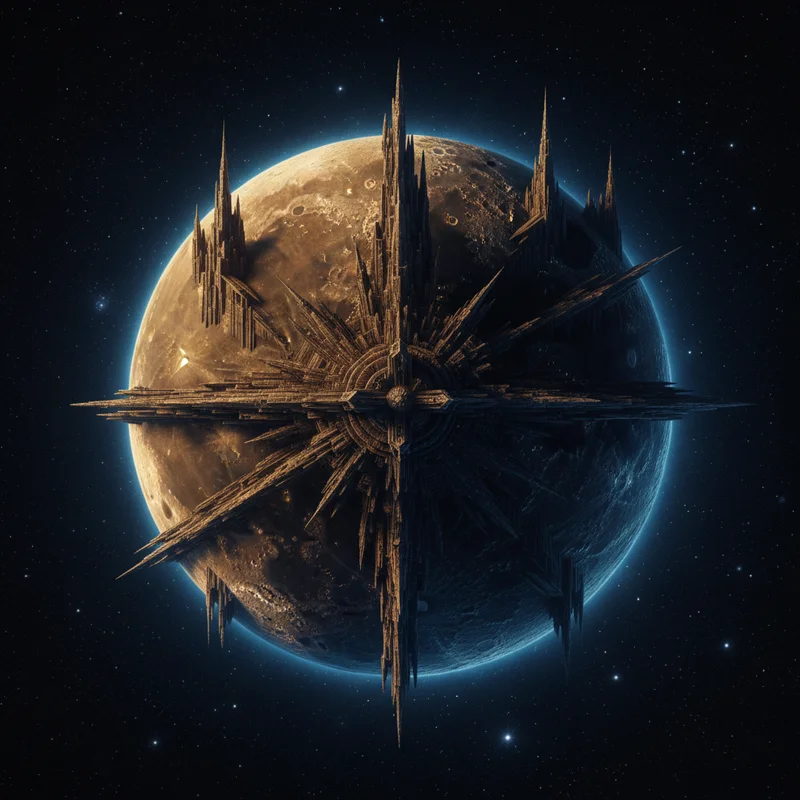
Topic Battle

Where Everything Fights Everything

The Moon

The Moon

Earth's natural satellite and space race destination.

VS
Time

Time

Dimension that refuses to slow down when needed.

Battle Analysis

Accessibility The Moon Wins
70%
30%
The Moon Time

The Moon

The Moon offers unparalleled celestial accessibility. Visible to the naked eye with a diameter half a degree across the night sky, it requires no telescope for appreciation. Approximately 7 billion humans can observe the Moon on any clear night, making it democracy's celestial favourite.

Only 12 humans have walked upon its surface, yet countless millions have photographed, painted, and pointed at it. The Moon is close enough for romantic association, far enough for aspirational dreaming. It hits, as they say, the celestial sweet spot.

Time

Time maintains perfect universal accessibility whilst remaining completely intangible. Every conscious being experiences time continuously, yet no one has ever touched, seen, or directly observed it. We perceive time's effects rather than time itself, much as we perceive wind through rustling leaves.

Time requires no clear skies, no equipment, no particular location. It is accessible in the deepest cave, the darkest night, the most confined space. One cannot escape time to gain perspective on it. This inescapable intimacy represents either ultimate accessibility or ultimate imprisonment.

VERDICT

The Moon can be observed and appreciated; time can only be endured
Romantic appeal The Moon Wins
70%
30%
The Moon Time

The Moon

The Moon has served as humanity's premier romantic backdrop since poetry began. Moonlit walks, moonlit dinners, moonlit proposals number in the billions. The phrase 'I love you to the moon and back' represents approximately 768,800 kilometres of devotion, a respectable romantic distance.

The full moon's illumination, at 0.25 lux, creates precisely enough light for faces to be seen but features softened. This biological accident has fuelled romantic encounters since before recorded history. The Moon is, quite simply, romance's greatest ally in the celestial sphere.

Time

Time and romance maintain a complicated relationship. 'Timeless love' suggests romance's transcendence of temporal constraints, yet most relationships require time to develop. Anniversary celebrations mark time's passage; 'quality time' ranks among relationship therapy's most prescribed remedies.

However, time also represents romance's greatest threat. Relationships age, passion fades, partners die. Time introduces wrinkles, forgetfulness, and the gradual realisation that one has been listening to the same anecdotes for decades. Time is romance's medium and its eventual executioner.

VERDICT

The Moon enhances romance; time eventually terminates it
Influence on earth Time Wins
30%
70%
The Moon Time

The Moon

The Moon exerts measurable gravitational influence on Earth's systems. Its tidal forces move approximately 500 cubic kilometres of water twice daily, creating the rhythmic pulse of coastal ecosystems. Intertidal zones, home to countless species, exist solely because of lunar gravity. The Moon stabilises Earth's axial tilt at 23.5 degrees, preventing the chaotic wobbling that would render seasons uninhabitable.

Without the Moon, Earth's day would last approximately 6 hours, and our planet would experience ice ages and heat waves in rapid, devastating succession. Lunar influence on human biology remains debated, though emergency rooms reliably report fuller waiting areas during full moons.

Time

Time's influence on Earth extends beyond measurement into ontology. Every geological process, from continental drift to mountain erosion, requires time as its medium. The Grand Canyon represents 6 million years of temporal patience. Evolution itself is simply time plus variation plus selection.

Time influences not merely what happens on Earth but that anything happens at all. Without time, causality collapses, and with it, every physical process. The Moon's influence is significant; time's influence is constitutive of reality itself. One shapes conditions; the other enables existence.

VERDICT

The Moon shapes Earth's conditions; time enables Earth's very existence
Cultural significance Time Wins
30%
70%
The Moon Time

The Moon

The Moon has dominated human mythology across every civilisation. From Artemis to Chang'e, from Thoth to Tsukuyomi, lunar deities number in the hundreds. The Moon features in approximately 15,000 songs catalogued in popular music databases, from Beethoven's Moonlight Sonata to Frank Sinatra's Fly Me to the Moon.

Apollo 11's lunar landing in 1969 remains humanity's most watched broadcast, with an estimated 600 million viewers. The Moon has inspired poetry, romance, and the phrase 'once in a blue moon,' which occurs approximately every 2.7 years and has nothing to do with colour.

Time

Time permeates every artistic and philosophical tradition in human history. From Ecclesiastes' 'a time to every purpose' to Einstein's relativistic revelations, time has generated more contemplation than any other concept. The word 'time' appears in English literature more frequently than any noun except 'man' and 'day.'

Entire genres exist to explore time: time-travel fiction, memoirs, historical novels, prophecy. Clocks appear in art from the 14th century onwards as symbols of mortality. Time has inspired not merely songs but the very concept of rhythm itself, without which music cannot exist.

VERDICT

The Moon inspires art about itself; time enables all art to exist temporally
Scientific importance Time Wins
30%
70%
The Moon Time

The Moon

The Moon serves as humanity's premier extraterrestrial laboratory. Analysis of lunar samples revealed the Giant Impact Hypothesis, explaining Earth's formation. The Moon's unchanging surface preserves 4 billion years of solar system history, a geological record erased on Earth by plate tectonics.

Lunar laser ranging experiments measure the Moon's recession from Earth at 3.8 centimetres per year, confirming tidal energy transfer theories. The Moon provides the only extraterrestrial surface humans have walked upon, making it scientifically invaluable as our sole comparative planetary data point.

Time

Time constitutes one of physics' fundamental dimensions. Einstein's spacetime revolutionised our understanding of gravity, motion, and cosmology. Time dilation has been confirmed to picosecond precision, with GPS satellites requiring constant temporal corrections.

The arrow of time, governed by the second law of thermodynamics, defines entropy's increase across the universe. Quantum mechanics introduces probabilistic temporal evolution through Schrodinger's equation. Time is not merely studied by science; it is foundational to scientific method itself, which requires before-and-after comparisons to function.

VERDICT

The Moon is studied by science; time is constitutive of scientific methodology
👑

The Winner Is

Time

45 - 55

In this celestial confrontation, we witness the curious dynamic between a beloved satellite and the dimension that contains it. The Moon, for all its cultural significance and gravitational influence, ultimately exists within time's jurisdiction. Every lunar phase, every tidal cycle, every Apollo mission unfolded across time's unyielding canvas.

The Moon wins humanity's affection through tangibility and romance, offering something to point at during philosophical discussions about our place in the universe. Time wins humanity's respect through sheer omnipotence, governing not merely lunar cycles but the very concept of cycles themselves.

With a final score of 45 to 55, Time claims victory not through any dramatic confrontation but through the quiet, irrefutable fact of containing all competitors within itself. The Moon is ancient; time is the very framework of ancientness.

The Moon
45%
Time
55%

Share this battle

More Comparisons