
Topic Battle

Where Everything Fights Everything

WiFi

WiFi

The invisible force that holds modern society together. Suddenly unavailable the moment you need it most, yet somehow strong enough in the bathroom three floors down at that coffee shop. The true test of any relationship.

VS
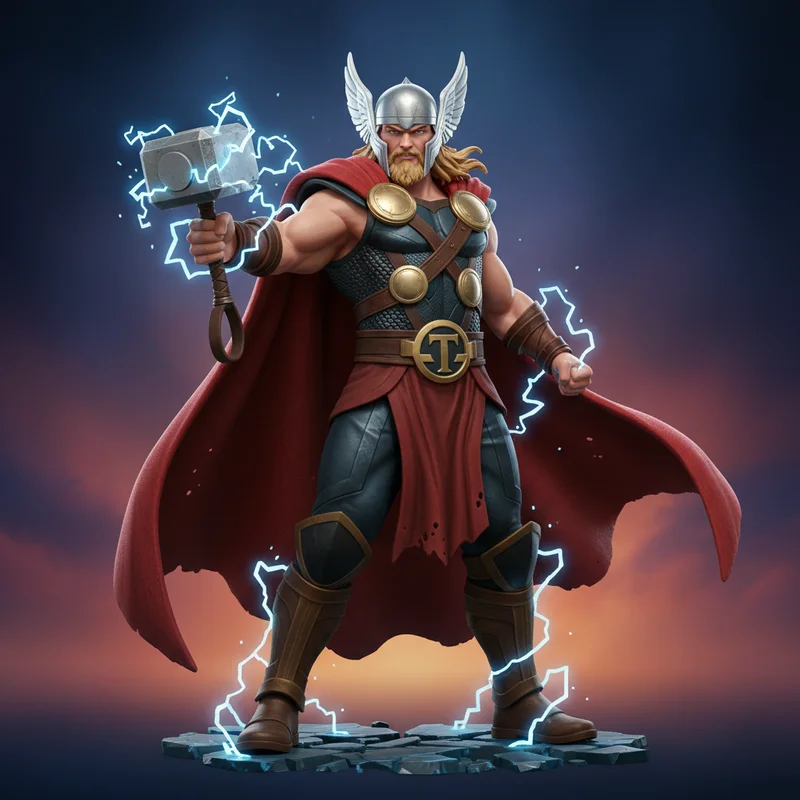
Thor

Thor

Norse god of thunder wielding Mjolnir.

Battle Analysis

Speed wifi Wins
70%
30%
WiFi Thor

WiFi

Modern WiFi operates at genuinely staggering velocities. The WiFi 6E standard delivers theoretical speeds of up to 9.6 Gbps, transferring data at rates that would have seemed like sorcery mere decades ago. A high-definition film can traverse the invisible waves in seconds. Financial transactions occur in milliseconds. The humble router, squatting anonymously in the corner of countless rooms, orchestrates this electromagnetic ballet with tireless efficiency. Speed, in the WiFi context, refers not merely to velocity but to the instantaneous nature of connection itself—the near-zero latency that allows video calls to flow and online games to function without perceptible delay.

Thor

Thor's speed capabilities are, by any reasonable measure, extraordinary. The God of Thunder can travel across the Nine Realms in moments, hurtling through space with his enchanted hammer extended before him like a divine cruise missile. He has been observed moving faster than the human eye can track, delivering blows that arrive before his opponents can process his movement. When Mjolnir is thrown, it travels at speeds that defy conventional physics, returning to Thor's hand regardless of distance or obstacles. Yet even Thor cannot match the speed of light—the velocity at which WiFi signals propagate. His impressive physicality remains bound by the limits of matter moving through space.

VERDICT

WiFi signals travel at light speed; Thor, whilst impressively swift, remains limited to sub-luminal velocities.
Reliability thor Wins
30%
70%
WiFi Thor

WiFi

Here we must address WiFi's most notorious weakness. The technology, for all its wonders, possesses a temperamental nature that has driven countless users to the brink of madness. Walls reduce its signal. Microwaves interfere with its frequencies. The router requires periodic rebooting with a frequency that suggests deep psychological instability. "Have you tried turning it off and on again?" has become the mantra of our age precisely because WiFi fails with such reliable unreliability. At the precise moment of an important video call, the signal chooses to weaken. During the climax of a streaming film, buffering appears. WiFi is a fair-weather friend, present during calm conditions and mysteriously absent during storms.

Thor

Thor's reliability, whilst generally impressive, is complicated by his personality. The God of Thunder has been known to abandon his duties on Asgard for extended periods, gallivanting across the Nine Realms on personal quests of varying urgency. He has experienced profound identity crises, periods of excessive ale consumption, and the occasional banishment by his father. Ragnarok itself represents a rather significant reliability failure. However, when Thor commits to a cause, his dedication becomes absolute. He has never mysteriously stopped working because someone in the next room turned on a microwave. He has never required rebooting. His hammer always returns when called.

VERDICT

Thor's commitment, once given, is unwavering; WiFi inexplicably fails when needed most.
Global reach wifi Wins
70%
30%
WiFi Thor

WiFi

WiFi has achieved something that even the most ambitious Roman emperor could scarcely imagine: near-total global penetration. From the bustling cafes of Paris to the remote villages of Mongolia, the invisible tendrils of wireless connectivity stretch across every continent. An estimated 4.9 billion people now rely upon WiFi for their daily communication, entertainment, and commerce. The technology operates on standardised frequencies that respect no national boundaries, requiring only a router and a power source to extend its digital embrace. Hotels advertise it before mentioning running water. Airports consider it more essential than comfortable seating. The humble WiFi signal has become so ubiquitous that its absence is now considered a humanitarian concern.

Thor

Thor's global reach, whilst impressive in mythological terms, operates on an entirely different scale. His influence stretches from the sacred texts of ancient Scandinavia to the gleaming screens of modern multiplexes. The Marvel Cinematic Universe has introduced the God of Thunder to audiences in over 150 countries, generating billions in revenue. However, Thor cannot be simultaneously present in every home, every pocket, and every public space. He must physically travel—admittedly via the spectacular Bifrost—to make his presence known. One might summon him in times of dire need, but one cannot stream Netflix through his person. His reach, though godly, remains fundamentally limited by the constraints of physical embodiment.

VERDICT

WiFi connects billions continuously; Thor's presence requires deliberate travel and cannot facilitate cat videos.
Cultural impact wifi Wins
70%
30%
WiFi Thor

WiFi

WiFi has fundamentally restructured human civilisation in ways that even its inventors could not have anticipated. The technology has created new industries, destroyed old ones, and transformed how humans communicate, work, and entertain themselves. Social movements organise through WiFi. Revolutions are coordinated via wireless signals. The very fabric of commerce has been rewoven around the assumption of constant connectivity. Coffee shops now compete primarily on signal strength rather than coffee quality. Libraries have evolved from temples of physical books to WiFi distribution centres that happen to contain some books. Human behaviour has been irrevocably altered by this invisible force.

Thor

Thor's cultural impact spans over a thousand years of human storytelling. The Norse god gave his name to Thursday, ensuring that every week contains a small tribute to his thunderous majesty. His mythology influenced literature from Wagner to Tolkien, his iconography appearing on everything from rune stones to heavy metal album covers. The Marvel interpretation has introduced Thor to entirely new generations, generating billions in merchandise and inspiring countless Halloween costumes. Yet Thor's impact, whilst profound, remains primarily in the realm of entertainment and mythology. He has not restructured how humans conduct their daily lives in the way WiFi has.

VERDICT

WiFi has fundamentally transformed human behaviour; Thor's impact, whilst ancient, remains largely cultural.
Intimidation factor thor Wins
30%
70%
WiFi Thor

WiFi

WiFi, it must be acknowledged, presents a profoundly non-intimidating appearance. The typical router is a modest plastic box, often beige or black, festooned with small antennae that blink green lights in patterns of no discernible significance. It makes no sound. It issues no threats. When WiFi fails, users experience frustration rather than fear—the quiet despair of the disconnected rather than the primal terror of the hunted. The most aggressive action a WiFi network can take is to request a password, and even this is done with clinical politeness. No one has ever fled in terror from a wireless access point.

Thor

Thor represents the apotheosis of intimidation. Standing over six feet tall with the physique of someone who has spent millennia in combat training, he projects an aura of barely contained divine violence. His eyes crackle with literal lightning. His voice carries the rumble of distant thunder. Mjolnir, that deceptively simple hammer, has shattered planets and humbled gods. When Thor enters a battlefield, enemies who moments before felt confident suddenly discover urgent appointments elsewhere. The God of Thunder does not negotiate; he arrives, and the negotiation has concluded. Even other Avengers—a group not typically known for timidity—defer to his presence when genuine smiting is required.

VERDICT

Thor's divine presence inspires genuine terror; WiFi's most threatening feature is a password prompt.
👑

The Winner Is

WiFi

54 - 46

This analysis has revealed a competition between fundamentally different categories of power. Thor represents the old conception of might—physical, visible, terrifying, and personal. WiFi embodies the new—invisible, ubiquitous, impersonal, and indispensable. The God of Thunder would undoubtedly triumph in any direct physical confrontation; no amount of radio waves can withstand Mjolnir. Yet WiFi has achieved something Thor never could: complete integration into the fabric of daily existence. Humanity does not pray to WiFi, but it does panic when WiFi disappears. The Norse god inspires awe and devotion; the wireless signal inspires dependency and expectation. In the final accounting, WiFi's quiet omnipresence edges out Thor's magnificent but bounded divinity. The electromagnetic wave has conquered the thunder god not through superior force, but through superior utility.

WiFi
54%
Thor
46%

Share this battle

More Comparisons